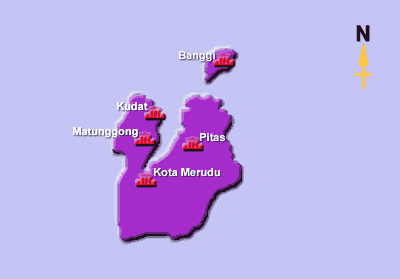
During our trail blazing act in Kudat we witness a tragedy. The bane of long haul travelling is the risk of involvement in road accident. It is normal for the human body to tire after exerting itself especially after non-stop driving. When such thing occur it is best to stop and rest. Then again such accident can be caused by the use of unregistered medicine. These medicine that is usually being marketed as traditional product is in fact adulterated with antihistamine that causes drowsiness rendering the user unable to operate heavy machinery. Unsuspecting user of such medicine does not know that unless it is declared on the product labels. In our travels and enforcement job we always keep safety as our top priority. We always stay on alert and adopt safe driving and of course pray before such journey.
The 4-WD Pickup on the ditch after the driver momentarily fell asleep on the wheels, swerved the vehicle to the opposite road lane, awoke and shocked to see an incoming car, made a sudden forced turn while slamming the brakes, the car made a 180 degrees tumble and turn turtle
Notice the mangled chassis due to the impact... The driver actually came out alive in this one...
Showing posts with label Malaysia. Show all posts
Sunday, August 10, 2008
Monday, August 4, 2008
Trail Blazing in Kudat
a living and they usually ignorant about the do and don't of medicine sales
One of the unregistered product laced with steroids found in one of the shops in Kudat. It's called Maajun Kuat and medicines sold in this form we called "Ubat Papan" has been banned by the authorities since 2005
Labels:
consumer education,
cpf sabah,
Kudat,
law,
Malaysia
Thursday, July 31, 2008
The Long Road Ahead
Being an enforcement agency, it's not all about flexing enforcement muscle and hard punishments. In fact the best form of enforcement is consumer education. We call this as 'proactive' enforcement. This method allows the reduction of demand from the consumer thus disrupting the "demand-supply chain" of unregistered health product. This is made possible by empowering the retailers to choose to sell registered helath product only. This effort involve an intelligent planning, precise execution and a lot of patience before reaping the desired results. On our part at CPF Sabah we have so far embarked on a few education campaign targeting multi-level members of the society. It is important to get the cooperation of everyone to ensure the success of law enforcement on medicine and pharmaceuticals. It's a long road ahead.
Tuesday, July 29, 2008
Importation Of Drug Into Malaysia
Many of us today take a lot of pride in using imported cosmetic product and also consuming imported medications. But have any one of us wondered how these products enter Malaysia? It is not as straight forward as some of us may think. This article is written with the hope to increase the public’s awareness regarding importation of drug and also cosmetic product.
In general, importation of drug into Malaysia is controlled by the Poisons Act 1952 and Control of Drugs and Cosmetics Regulations 1984 to ensure ‘Controlled Medicines” are imported by licensed pharmacists and to ensure medicines imported are safe, efficacious and of quality.
Before any drug can be considered to be imported into Malaysia, it must first be registered with the Drug Control Authority. Public can check whether a product is registered or not by contacting the National Pharmaceutical Control Bureau at 03-78835400 or search the website http://www.bpfk.gov.my/ . After the product is registered, the importer has to apply for an import licence to import the registered product.
Under the Poisons Act 1952, poisons means any substance listed in the first column of the Poisons List. You need an appropriate licence to import poisons. Type A license is for a licensed pharmacist to import all poisons . A type B license can be issued to any person deemed proper or fit by a licensing officer to import industrial chemicals controlled as poisons and a Type E licence to import sodium hydroxide. Application of any of the above license can be done through the Pharmacy Enforcement Division (Cawangan Penguatkuasa Farmasi). Any person found guilty of committing offences under this Act, is liable to a fine not exceeding RM 5000 or imprisonment not exceeding 2 years or both.
Starting this year (2008) under the Control of Drugs and Cosmetics Regulation 1984 importer must notify the DCA the cosmetics they intend to put in the market. Prior to this cosmetics also need to be registered with DCA, This is in-line with the harmonization requirement amongst ASEAN countries. For any query, don’t hesitate to call the local Pharmacy Enforcement Division near you.
© Sabah State Pharmacy Enforcement Branch
In general, importation of drug into Malaysia is controlled by the Poisons Act 1952 and Control of Drugs and Cosmetics Regulations 1984 to ensure ‘Controlled Medicines” are imported by licensed pharmacists and to ensure medicines imported are safe, efficacious and of quality.
Before any drug can be considered to be imported into Malaysia, it must first be registered with the Drug Control Authority. Public can check whether a product is registered or not by contacting the National Pharmaceutical Control Bureau at 03-78835400 or search the website http://www.bpfk.gov.my/ . After the product is registered, the importer has to apply for an import licence to import the registered product.
Under the Poisons Act 1952, poisons means any substance listed in the first column of the Poisons List. You need an appropriate licence to import poisons. Type A license is for a licensed pharmacist to import all poisons . A type B license can be issued to any person deemed proper or fit by a licensing officer to import industrial chemicals controlled as poisons and a Type E licence to import sodium hydroxide. Application of any of the above license can be done through the Pharmacy Enforcement Division (Cawangan Penguatkuasa Farmasi). Any person found guilty of committing offences under this Act, is liable to a fine not exceeding RM 5000 or imprisonment not exceeding 2 years or both.
Starting this year (2008) under the Control of Drugs and Cosmetics Regulation 1984 importer must notify the DCA the cosmetics they intend to put in the market. Prior to this cosmetics also need to be registered with DCA, This is in-line with the harmonization requirement amongst ASEAN countries. For any query, don’t hesitate to call the local Pharmacy Enforcement Division near you.
© Sabah State Pharmacy Enforcement Branch
Pharmacy Enforcement Branch: An Introduction
The Sabah State Pharmacy Enforcement Branch was established since 30 August 1978. It was known then as the Drug Inspection and Enforcement Unit. The first area office was located at 1st Floor, Block A, Warehouse, Karamunsing, Kota Kinabalu. At that time it was the only branch in Sabah with one pharmacy enforcement officer and a pharmacy assistant. From this humble beginning, the office has since extended to having three other area branches in Tawau, Sandakan and Keningau.
The Pharmacy Enforcement Branch is a unit under the Sabah State Health Department, a federal department under the Ministry of Health, Malaysia. Authorized officers who work in this unit are known as Pharmacy Enforcement Officers. What do enforcement officers do? Other than inspecting and raiding shops, there are also other activities that they do. This article will explain the entire picture as a whole.
The Pharmacy Enforcement branch has an important role to protect the health and well-being of the public from the harm of unregistered product. This is done by enforcing the Control of Drugs and Cosmetics Regulations 1984 to control the importation, manufacture, supply, storage, sale, possession and usage of pharmaceutical products. In other words, pharmacy enforcement activities ensure health products used in this country are of good quality, safe and effective.
The Pharmacy Enforcement also processes various licenses and permits applications under the Poisons Act 1952 and its Regulations :
Poisons License Type A - for pharmacist to deal with all poisons
Poisons License Type B - for non-pharmacists to import and do wholesale of industrial chemicals which are controlled as poisons. Sodium Hydroxide Permit - for companies to buy and use Sodium Hydroxide
Apart from issuing poison licenses, the branch also carry out routine checks on clinics, pharmacies and licensed wholesalers of poisons. The main aim is to ensure all poisons are handled, transacted and labeled properly for the safetyof members of the public. During inspection, poisons are checked to ensure they are stored properly - in a room under lock and key. Checking of records on all transactions involving s poisons is to ensure all transaction is legal. Poisons here includes medicines that can cause harm to the public if misused. For instance, medicines that contain poisons can only be supplied by doctors and pharmacists. Other establishment i.e. non-licensed premises and roadside sellers are also inspected to ensure they do not sell medicines containing poisons. Further information can be obtained from the website http://http://www.pharmacy.gov.my/.
Dduring routine checks unregistered products will be confiscated if they are found.. These are products that do not have a specific assigned ‘MAL number’ and hologram sticker. Unregistered products here are medicines including traditional medicines that are not registered with the Drug Control Authority. These products have not been evaluated for their safety, quality and efficacy. Information on registration of products is available at http://www.bpfk.gov.my
Another important enforcement activity by the branch is the control of advertisements of medicinal products and advertisement relating to health or medical services in the mass media and other forms of advertisement eg banners and pamphlets. Advertisements which are approved by the Medicines Advertisement Board are given “KKLIU” approval number and can be published
Activities carried out at the entry points involve screening of import document, checks on parcel post and checks on passengers to prevent entry of unregistered health products and importation of chemical without authorization at the sea port, airport terminals and post-office. Unregistered products or consignements which do not have proper authorizations will be confiscated.
Over the years the Pharmacy Enforcement branch has intensified its activity to contain the problem of unregistered producst. Looking at the figures for the year 2006, the raids themselves contributed to RM476,673.00 worth of poisons and unregistered products seized from traditional medicine stores, unlicensed wholesalers, beauty saloons and pharmacies while seizures of products at entry points amounted up to RM850,000.00.
With the advent of globalization and the limited resources that are available, the Pharmacy Enforcement branch will continue to evolve to meet challenges ahead. Recognising the influence the public have on purchasing trends of pharmaceutical products, healthcare products and cosmetic in the country, the focus of Pharmacy Enforcement will be unto public enlightenment. It is important that the public takes responsibility to ensure the medicines they buy are safe. They must be able to differentiate between ethical and unethical advertisements. We can only achieve these health goals if everyone is in it together. Pharmacy Enforcement branch is here to protect the public from the harm of unregistered products. If the public require any information on the handling or sale of chemicals or health products you can visit us on the 9th Floor, Block D of the KWSP Building, off Karamunsing Road, Kota Kinabalu or call the number 088-231609 / 231610 or by mail to P.O. Box 10607, 88806 Kota Kinabalu or e-mail to cpf@sbh.moh.gov.my. In the near future we will be moving to the 6th Floor of the Federal House, Jalan Mat Salleh, Kota Kinabalu.
© Sabah State Pharmacy Enforcement Branch
The Pharmacy Enforcement Branch is a unit under the Sabah State Health Department, a federal department under the Ministry of Health, Malaysia. Authorized officers who work in this unit are known as Pharmacy Enforcement Officers. What do enforcement officers do? Other than inspecting and raiding shops, there are also other activities that they do. This article will explain the entire picture as a whole.
The Pharmacy Enforcement branch has an important role to protect the health and well-being of the public from the harm of unregistered product. This is done by enforcing the Control of Drugs and Cosmetics Regulations 1984 to control the importation, manufacture, supply, storage, sale, possession and usage of pharmaceutical products. In other words, pharmacy enforcement activities ensure health products used in this country are of good quality, safe and effective.
The Pharmacy Enforcement also processes various licenses and permits applications under the Poisons Act 1952 and its Regulations :
Poisons License Type A - for pharmacist to deal with all poisons
Poisons License Type B - for non-pharmacists to import and do wholesale of industrial chemicals which are controlled as poisons. Sodium Hydroxide Permit - for companies to buy and use Sodium Hydroxide
Apart from issuing poison licenses, the branch also carry out routine checks on clinics, pharmacies and licensed wholesalers of poisons. The main aim is to ensure all poisons are handled, transacted and labeled properly for the safetyof members of the public. During inspection, poisons are checked to ensure they are stored properly - in a room under lock and key. Checking of records on all transactions involving s poisons is to ensure all transaction is legal. Poisons here includes medicines that can cause harm to the public if misused. For instance, medicines that contain poisons can only be supplied by doctors and pharmacists. Other establishment i.e. non-licensed premises and roadside sellers are also inspected to ensure they do not sell medicines containing poisons. Further information can be obtained from the website http://http://www.pharmacy.gov.my/.
Dduring routine checks unregistered products will be confiscated if they are found.. These are products that do not have a specific assigned ‘MAL number’ and hologram sticker. Unregistered products here are medicines including traditional medicines that are not registered with the Drug Control Authority. These products have not been evaluated for their safety, quality and efficacy. Information on registration of products is available at http://www.bpfk.gov.my
Another important enforcement activity by the branch is the control of advertisements of medicinal products and advertisement relating to health or medical services in the mass media and other forms of advertisement eg banners and pamphlets. Advertisements which are approved by the Medicines Advertisement Board are given “KKLIU” approval number and can be published
Activities carried out at the entry points involve screening of import document, checks on parcel post and checks on passengers to prevent entry of unregistered health products and importation of chemical without authorization at the sea port, airport terminals and post-office. Unregistered products or consignements which do not have proper authorizations will be confiscated.
Over the years the Pharmacy Enforcement branch has intensified its activity to contain the problem of unregistered producst. Looking at the figures for the year 2006, the raids themselves contributed to RM476,673.00 worth of poisons and unregistered products seized from traditional medicine stores, unlicensed wholesalers, beauty saloons and pharmacies while seizures of products at entry points amounted up to RM850,000.00.
With the advent of globalization and the limited resources that are available, the Pharmacy Enforcement branch will continue to evolve to meet challenges ahead. Recognising the influence the public have on purchasing trends of pharmaceutical products, healthcare products and cosmetic in the country, the focus of Pharmacy Enforcement will be unto public enlightenment. It is important that the public takes responsibility to ensure the medicines they buy are safe. They must be able to differentiate between ethical and unethical advertisements. We can only achieve these health goals if everyone is in it together. Pharmacy Enforcement branch is here to protect the public from the harm of unregistered products. If the public require any information on the handling or sale of chemicals or health products you can visit us on the 9th Floor, Block D of the KWSP Building, off Karamunsing Road, Kota Kinabalu or call the number 088-231609 / 231610 or by mail to P.O. Box 10607, 88806 Kota Kinabalu or e-mail to cpf@sbh.moh.gov.my. In the near future we will be moving to the 6th Floor of the Federal House, Jalan Mat Salleh, Kota Kinabalu.
© Sabah State Pharmacy Enforcement Branch
The Use of Registration Number for Product Identification
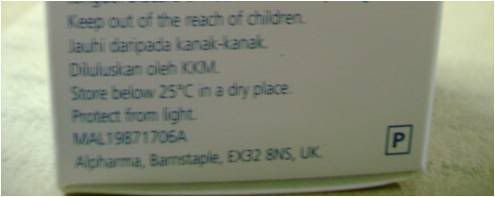
Each 'Unit of Use' (for consumer use) of the registered product carry specific ID no. with assigned alphabets according to their type. This is called the Product registration no. It starts with the alpahabet "MAL" followed by an 8 digit no. and the alphabet that denote that particular type of product. The one's that can be found in the market include;
1. MAL07052345A - Controlled Medicine
2. MAL06039876X - OTC product
3. MAL05073233T - Traditional product
Monday, July 28, 2008
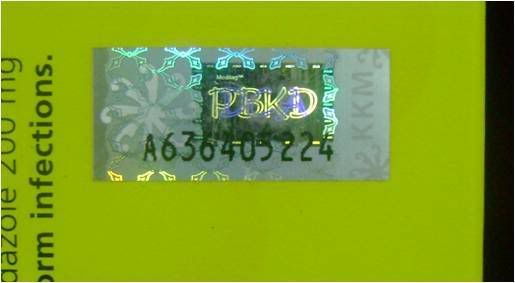
This is how a hologram on a Registered Product in Malaysia Looks like
Subscribe to:
Posts (Atom)