Have you been asked the name of your current medicine?
Can you name the medicine that you are taking?
Do you check the label for each medicine that you receive from the hospital, clinic or retail pharmacy?
If you answer “no” to any of the questions above please spend time to read this article now.
Compulsory Requirement for Labelling of Medicine
According to the Poisons Regulations 1952, when any poisons is supplied as a dispensed medicine it shall be labelled with certain details. This includes the name and address of the supplier or seller (in this case the Clinic, Hospital and Pharmacy it was obtained), name of the person whom the medicine is for, name of the medicine and adequate direction for the use of such medicine. Tthe medicine pack should also have the reference number as in the record called the ‘Prescription Book’ and the words ‘Controlled Medicine’.

(Pic above shows the proper labelling of dispensed medicine)
Consumer Responsibility
The government always advocates Malaysians to be smart consumers. One small step to achieve this aspiration is to read the medicine label and to know the medicine supplied to you. It’s not a surprising fact that certain members of the public neglects to read the label of their medicine. Whether this medicine is obtained from hospital, clinic, or retail pharmacy, many of us don’t take the time to read or to ask about the medicine we received. Please find the time at the end of this article to check your medicine cabinet and look at the medicine label that many of us are currently taking, it’s not surprising to find dispensed medicine labelled with the words ‘Sakit Perut’, headache, ‘muntah-muntah’, ‘cuci darah’, and many more. Some might find this amusing and strange but the bottom line it’s a sad reality. The paradigm shift in medical care is to encourage the patient to play an active role in treatment of their illnesses. The patient can play this role by taking the initiative to ensure that their medicine is clearly and completely labeled. Request the doctor or pharmacist who supplies the medicine to label the medicines properly. All patients whether adults or children have the right to expect the medicine supplied to them are appropriate, safe and effective. By fulfilling this basic consumer responsibility it is hoped that consumer will be familiar with the medicine that they are taking and take more responsibility in their treatment.
Supplier Responsibility
An example of professional duty in the medical field is to inform matters related to any diseases or medicine involving such patients in accordance with the standard clinical guidelines that focuses on the patient (patient centered). All doctors, dentists or pharmacist must ensure that the label of dispensed medicine conforms to the law. In any government medical institutions, labeling of medicine with generic or chemical name has become a norm. Such practices should be implemented in all private hospitals, clinics and retail pharmacies for the benefit of the patients. For example the common painkiller medicine containing the chemical Mefenamic Acid has been registered undert the names like Ponstan, Beafemic, Dyfenalic, Fenagesic, Hamitan, Mefemic etc. The practice of labelling using chemical name is important because it allows the consumer to know the active ingredients in each medicine and help to avoid any toxicity that might arise due to the administration of different medicines with the same active ingredients. .
Advantage of Proper Labeling
The advantages of having a proper label of medicine are as follows;
1.The patient can obtain further information about that particular medicine from reliable information sources or by referring the medicine by name to doctors and pharmacists
2. Improve patients compliance to maximize the treatment effectiveness
3. Patients able tell the name of medicine they are taking to doctors or pharmacist to avoid duplication of therapy especially for those seeking second opinion from different healthcare provider for a particular illness.
4. If adverse effects or allergic reaction occur, it will be easy for patient to recognize the medicine that causes it and to report the matter to their medical provider.
5. The patient will be able to stop taking medicine which has an active ingredient which is banned
6. Easy to understand the direction, frequency and duration of treatment for that particular medicine
7. Know the medicine proper and safe storage
8. Avoid cases of medicine mistakenly consume by individuals living in the same house.
In conclusion, by taking the initiative to ensure your medicines are labelled properly, all of us choose to become smart consumers and take full charge in the treatment of our illness.
© Sabah State Pharmacy Enforcement Branch
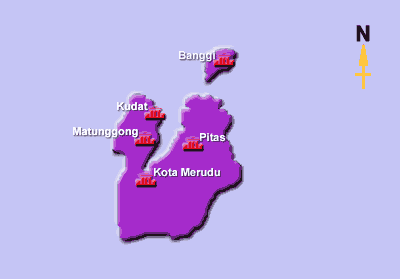 The map above is the District of Kudat, one of the 5 main district in Sabah. Our campaign in this district has been progressing steadily since 2004. Most of the main town located in this locality namely Kota Marudu, Pitas, Matunggong and Kudat has been visited except for Banggi island. Initially the consumer education campaign starts off from the main towns targeting health facilities like medicine shops, supermarkets, medical halls and groceries stores. Whereas Clinics and Pharmacy in these towns had been monitored since the 90's. The campaign has progress steadily to sundries shop in the outskirts of town. Lately there have been a trend of irresponsible parties to distribute unregistered health product to the rural areas. This is due to the dwindling market for their goods in the town area due to increase awareness in registered product sale. It has been encouraging to note that most retailers in the town areas know about health product registration and sale. This can be partly attributed to the efforts by licenced wholesalers who themselves have been informed about the product registration during a campaign blitz in 2004 by the department. This is an example of smart partnership between the enforcement agency and the bussiness community namely health product licensed wholesaler. We need to work together hand in hand for the journey ahead. Here are some graphic glimpses of our campaign trail in Kudat.
 Sundry shop owners are usually honest people trying to earn
  Note the simple design of the shop.. wooden structure on stilts with wire mesh
 Sundry shop being far from town becomes a multi-goods stores that sells anything from diesel (for generators), to cooking gas to medicines and other daily necessities. This makes them perfect targets for unregistered medicines supplier


 Posts
Posts


