 Our office is situated in the KWSP office building complex. It is perched in the 9th floor of block D as per photo below (it's the inner square folks).
  Our office is situated in the KWSP office building complex. It is perched in the 9th floor of block D as per photo below (it's the inner square folks).
 The day after, we woke to a beautiful morning, warm sun and scenic ocean view


 The small township is such laid back that a shop owner was manning his shop half naked ie. in his shorts and slippers and nothing else. The man actually greeted us as 'Cikgu' or teacher in Bahasa Malaysia before we introduced ourselves as enforcement officer. Maybe it's because of the black and white attire thingy. All in all the overall knowledge on registered health product is quite satisfactory here in Sikuati. One of the shop proprietor even asked the consequences of selling / possessing unregistered product before we even get to the penalty part. We solemnly informed him that it's a fine not more than RM25,000 or jail sentence of not more than 3 years or both. After covering 8 shops, we wrap it up and went back to Kota Kinabalu.
 Wisma Sabah a historic building situated at one of the city main entrance, we are almost exiting the city perimeter
 The roudabout near Yayasan Sabah.. yep we are definately exiting the city..
 This may look like a humble abode to some.. but actually it is a sundry shop smack right near the roadside near Menggatal-Sepanggar area. Where there is medicine we stop by for a check
  Fast forward aftter passing by Tuaran we encountered this unique premise. It sure gives a new dimension to the term 'shop house'. Extreme right is the house on stilts for residence and ground floor is the sundry shop connected to the roadside by a bridge structure..
 Another of the shop house minus the bridge structure plus a cow and a motorbike
 Freshly planted paddy field along the way.. beautiful green carpet
 It is a long way to go.. look at the blue cloudy sky
 Oopps I spoke to soon, it looks like the sky is about to fall on us...
 It sure looks like a storm is brewing.. maybe we can outrun it
 Look at the destruction....
 Careful there now.. we don't want any untoward incidence to happen..
 Another damaged road strecth ahead..
 Another sundry shop with local produce and handycraft.. we gotta check 'em all
 Another 70km to go..
 Fast forward.. after having lunch we got down straight to bussiness. Well okay it's not actually in Sikuati but in Kudat town.
 Mum is out and the daugther has the shop all to herself. She's quite smart for her age. We left some educational material for her mom. It has been a long day.. dealings in the District Council and 4 inspections we are ready to call it a day. Next stop is the Court proceeding in Kudat Magistrate Court followed by the Sikuati campaign. Stay tuned.


 As reported in a newspaper, an accused found out the hard way...

 This is the West Coast district. Our consumer education campaign here started back in 2003 targeting business wholesaler and retailers. In 2004, we shifted our target group to the general consumers or should we say the plain Joe and Jane of the community. With our Regional Headquarters situated in Kota Kinabalu City and the towns being within reach of the office, it is only natural that these neighbouring towns should be eradicated from unregistered products. Although we can't claim that we manage to achieve 100% eradication but it is not too much to state that most licensed premises in this locality don't sell unregistered product openly.
 The lady owner seems happy and she's very cooperative even though her unregistered medicine was seized
 A Tamparuli grocery store that we inspected, look at the colonial-era wooden shop house design.. difficult to find such shop in the city..
The eye said it all... this Indian national according to the travel documents issued to him is allowed to work as a Restaurant helper... instead he became a medicine peddler in a makeshift stall in Ranau... go figure
 Even a clothing store is getting into the act of selling unregistered medicine
 Toiletries and medicine section of the clothing store in Ranau
 Unregistered skin ointments from China (the boxes in the middle) labelled as containing scheduled poisons anti fungals
 The lack of pharmacy and a limited number of medical clinics.. medicine shop such as above is thriving in the rural area. Don't be surprised if they sell controlled medicines just like in any pharmacy or clinic.
 The 4-WD Pickup on the ditch after the driver momentarily fell asleep on the wheels, swerved the vehicle to the opposite road lane, awoke and shocked to see an incoming car, made a sudden forced turn while slamming the brakes, the car made a 180 degrees tumble and turn turtle
 Notice the mangled chassis due to the impact... The driver actually came out alive in this one...
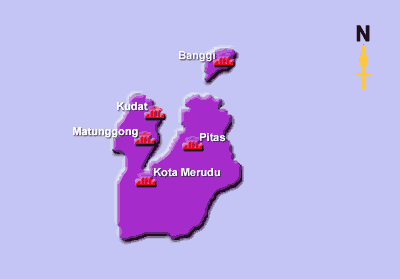 The map above is the District of Kudat, one of the 5 main district in Sabah. Our campaign in this district has been progressing steadily since 2004. Most of the main town located in this locality namely Kota Marudu, Pitas, Matunggong and Kudat has been visited except for Banggi island. Initially the consumer education campaign starts off from the main towns targeting health facilities like medicine shops, supermarkets, medical halls and groceries stores. Whereas Clinics and Pharmacy in these towns had been monitored since the 90's. The campaign has progress steadily to sundries shop in the outskirts of town. Lately there have been a trend of irresponsible parties to distribute unregistered health product to the rural areas. This is due to the dwindling market for their goods in the town area due to increase awareness in registered product sale. It has been encouraging to note that most retailers in the town areas know about health product registration and sale. This can be partly attributed to the efforts by licenced wholesalers who themselves have been informed about the product registration during a campaign blitz in 2004 by the department. This is an example of smart partnership between the enforcement agency and the bussiness community namely health product licensed wholesaler. We need to work together hand in hand for the journey ahead. Here are some graphic glimpses of our campaign trail in Kudat.
 Sundry shop owners are usually honest people trying to earn
  Note the simple design of the shop.. wooden structure on stilts with wire mesh
 Sundry shop being far from town becomes a multi-goods stores that sells anything from diesel (for generators), to cooking gas to medicines and other daily necessities. This makes them perfect targets for unregistered medicines supplier
One of the unregistered product laced with steroids found in one of the shops in Kudat. It's called Maajun Kuat and medicines sold in this form we called "Ubat Papan" has been banned by the authorities since 2005
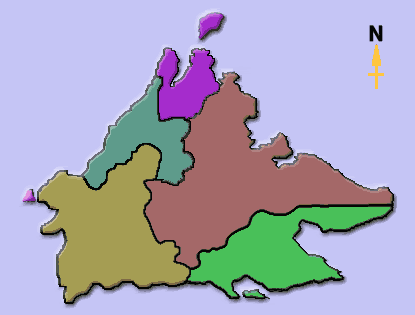 This is Sabah, Malaysia where where we currently enforce 4 laws pertaining to medicine, chemical and health product. Sabah land mass is about 73,631 sq. km area, the northern most part of the island of Borneo and east of the capital city of Malaysia,Kuala Lumpur. It is known as the Land Below the Wind (a name coined by an Englishwoman Agnes Keith, a writer). In our language we term it as "Sabah Negeri di Bawah Bayu". Sabah basically consist of 5 main districts. There are (please see map above) clockwise from top Kudat, Sandakan, Tawau, Interior and West Coast. Currently up to this date, we have a strength of 12 enforcement officers to cover the whole of Sabah. 2 officers based in Tawau, 1 each in Sandakan and Keningau and the rest at our HQ in Kota Kinabalu. Simple math tells you 1 enforcement officer per 6,135 sq. km, a daunting task but we relish the challenge.


 Posts
Posts


